3 AM and Wide Awake: How Tokyo Built a World for People Who Never Sleep
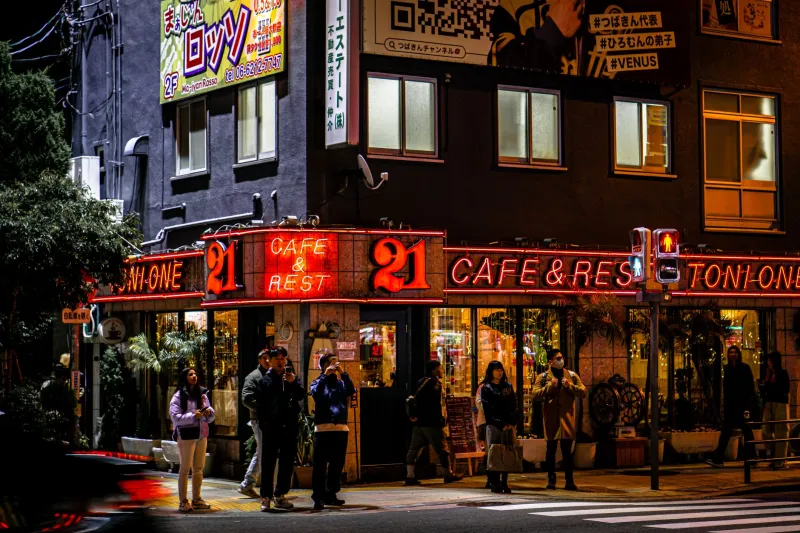
Somewhere between midnight and sunrise, Tokyo does something most cities don't — it keeps going. Not just the convenience stores and the ramen joints, but actual communities. People with laptops open and headphones on. Strangers sharing outlet strips and quiet nods. A whole parallel society running on caffeine, Wi-Fi, and the shared understanding that 9-to-5 was never really for everyone.
If you've spent any time in the US, you know the feeling of being the only person awake at 2 AM, staring at a ceiling while the rest of your neighborhood sleeps. Tokyo fixes that. And more and more Americans — remote workers, creative types, people chasing time zones or just their own weird rhythms — are figuring that out.
The Infrastructure of Insomnia
Tokyo's round-the-clock culture isn't an accident. It's infrastructure. The city has more 24-hour establishments per square mile than almost anywhere on earth, and they range from the utilitarian to the genuinely surprising. Family Mart and 7-Eleven are the obvious anchors — stocked with hot food, decent coffee, and a warm glow that feels almost human at 3 AM. But those are just the entry points.
Dig a little deeper and you find manga cafes — called manga kissa — that have quietly evolved into something between a hostel, a coworking space, and a sensory deprivation pod. For around $10 to $15 an hour, you get a private booth, unlimited drinks, a computer, and access to thousands of comics. Some people come to read. Others come to work. A few come because they missed the last train and need somewhere to land. Nobody asks too many questions.
Then there are the dedicated late-night coworking spots. Places like Shibuya's basement-level work cafes that stay open through dawn, attracting a rotating cast of freelancers, startup founders, and remote employees syncing up with colleagues in New York or Los Angeles. The vibe in these spots is hard to describe to someone who hasn't been there — focused but not tense, solitary but not lonely. Everyone's in their own world, but somehow it still feels communal.
Why Digital Nomads Are Choosing Tokyo Over Bali
For a long time, the digital nomad conversation centered on Southeast Asia — cheap rent in Chiang Mai, co-living spaces in Canggu, that kind of thing. Tokyo rarely made the shortlist, mostly because of cost. But the calculus has shifted.
The yen's relative weakness against the dollar over the past few years has made Tokyo dramatically more affordable for Americans than it used to be. A night in a quality manga cafe costs less than a cocktail at a rooftop bar in Manhattan. A full meal at a 24-hour diner in Shinjuku might run you $8. Suddenly, Tokyo stops looking expensive and starts looking like a deal — especially when you factor in the safety, the transit system, and the fact that the Wi-Fi almost never fails.
But beyond the economics, there's something about Tokyo's nocturnal culture that genuinely fits the remote work lifestyle. No one's going to give you side-eye for working at 4 AM. The city's social norms around minding your own business — often misread by outsiders as coldness — actually create a weirdly ideal environment for people who need to focus. You're anonymous in the best possible way.
The Unexpected Social Scene
Here's the part that surprises most people: the night shift community in Tokyo isn't just about grinding alone. It has its own social ecosystem, and it's more vibrant than you'd expect.
In neighborhoods like Shimokitazawa and Koenji, certain late-night cafes have become unofficial gathering spots for expats, international students, and local creatives who keep odd hours. These aren't bars exactly — more like living rooms that happen to sell coffee and occasionally host acoustic sets at midnight. You'll find people swapping freelance leads, trading book recommendations, or just killing time between video calls with people twelve time zones away.
There's also a quieter kind of connection that happens in 24-hour spaces — the kind built on proximity and repetition. See the same person at the same corner of the same manga cafe three nights in a row, and something shifts. You don't necessarily talk. But there's a recognition, a mutual acknowledgment that you're both out here, doing your thing, making it work. In a city of 14 million people, that can feel like a lot.
Where to Start If You're New to the Night
If you're visiting Tokyo and curious about this side of the city, Shinjuku is the obvious jumping-off point — it's got the density and the anything-goes energy that makes nocturnal wandering feel natural. The area around Kabukicho has plenty of 24-hour options ranging from sketchy-fun to genuinely comfortable. Shibuya's backstreets are worth exploring too, especially if you're looking for something with more of a creative, younger crowd.
For actual work, look for spots that advertise netto cafe or waku supeesu (work space) — Google Maps will surface options near most major train stations, and reviews will tell you pretty quickly which ones have reliable Wi-Fi and which ones are mostly there for the vibe.
And if you're just looking to feel less alone at 3 AM in a foreign city? Walk into any well-lit 24-hour diner, order whatever's on the picture menu, and watch the city breathe around you. That's the real night shift economy — not a hustle, just a different way of being awake.