Speak Easy or Stay Home: Cracking the Unwritten Code of Tokyo's Most Secretive Spaces
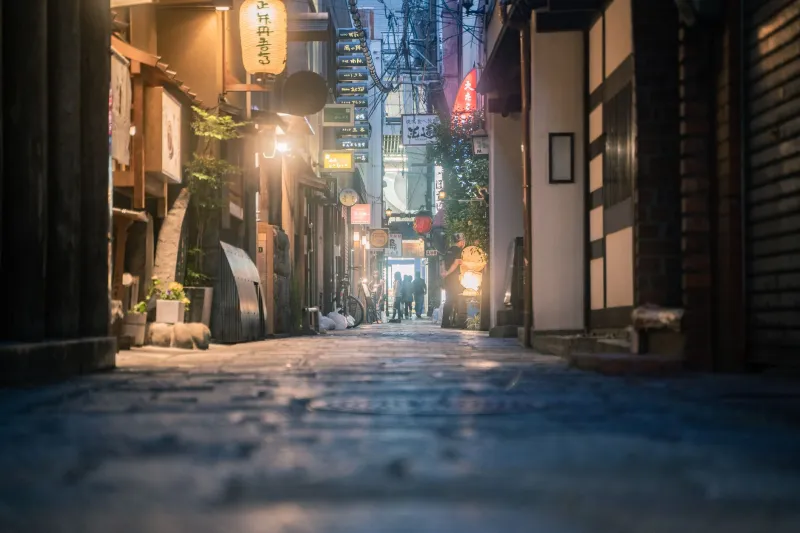
There's no bouncer at the door. There's barely a door. What there is, if you know where to look, is a small strip of orange tape on the underside of a mailbox in Shimokitazawa, or a single kanji written in chalk on a sidewalk near Koenji that'll be washed away by morning. To the average passerby — tourist, salaryman, delivery guy — it's nothing. To the right person, it's an invitation.
Welcome to the part of Tokyo that doesn't need to explain itself.
The City That Communicates in Whispers
Tokyo has always had a complicated relationship with visibility. Historically, everything from jazz clubs to gambling dens operated under layers of indirection — not just for legal reasons, but because exclusivity is the culture. If everyone knows about a place, it stops being what it was. That's not elitism for the sake of it. It's preservation.
What's evolved out of that instinct is something genuinely fascinating: a city-wide system of informal communication that operates completely parallel to the mainstream. No apps, no press releases, no sponsored posts. Just signals that mean something only to the people they're meant for.
And it's not one system. It's dozens, layered on top of each other, neighborhood by neighborhood, scene by scene.
Instagram Stories as Morse Code
The most accessible version of this language lives on social media — but barely. A promoter in Nakameguro might post a single image at 11:47 PM on a Tuesday: a photo of a specific alley, no caption, no location tag, gone in 24 hours. To a stranger, it's aesthetic content. To a regular, it's a specific address, a specific night, and an implicit understanding that you don't screenshot it.
That last part matters more than people realize. Screenshots travel. Screenshots get posted in group chats, forwarded to friends of friends, and suddenly a 40-person gathering turns into 200 people standing outside a warehouse in Ebisu with no idea why the door isn't opening.
"It happened to us twice," says one organizer who runs small listening parties across different Tokyo neighborhoods — she asked not to be identified by name or neighborhood, which is itself very on-brand. "The second time, we had to shut down before midnight because someone had shared the location publicly. After that, we changed how we communicate completely. Now people have to already be in the right group chat to even see the first clue."
The group chat, by the way, is invite-only. Getting into the group chat requires being vouched for by two existing members. Getting vouched for requires actually showing up somewhere, in person, and being remembered.
Physical Signals, Analog Gatekeeping
Not everything is digital. Some of the most reliable communication in Tokyo's underground is still stubbornly, deliberately physical.
In certain parts of the city — particularly around older shotengai shopping streets in areas like Kagurazaka or the back alleys of Sangenjaya — small visual markers do real work. A specific color of cloth in a window. A sticker placed at a certain height on a utility pole. A plant moved from one side of an entrance to another. These aren't elaborate spy-movie setups. They're just low-tech, low-risk, and invisible to anyone who isn't already looking.
Hand signals exist too, though they're less cinematic than you'd imagine. At certain door situations — and "door" is being used loosely here, it might be a sliding panel, a curtain, a person standing casually near a staircase — there are nods, specific ways of holding a phone, even the direction you approach from that communicates your status. First-timers usually get walked through it by whoever brought them. Showing up solo without that briefing is a fast way to spend a night standing on a sidewalk.
What Happens When Outsiders Get It Wrong
This is where it gets genuinely complicated, especially for foreign visitors.
The US has its own version of underground culture — warehouse parties in Brooklyn, unmarked bars in Chicago's Logan Square, secret shows in LA garages — but the social contract around discretion operates differently. American underground culture tends to celebrate its own existence, at least a little. There's pride in knowing. There's often an eventual Instagram post, a write-up, a moment where the secret becomes a story.
In Tokyo, the story is the silence. The keeping of it.
Foreigners, even well-meaning ones, sometimes miss this. Not out of malice — out of genuine enthusiasm. They find something incredible, they want to share it, and they post about it the way they'd post about a great taco spot back home. The difference is that a taco spot wants to be found. These spaces don't.
"I've seen people get quietly removed from communities for exactly this," says one Tokyo-based American who's been embedded in the city's underground music scene for several years. "Nobody yells at you. Nobody confronts you. You just stop getting the messages. The invitations stop coming. And you might not even realize why for months."
That soft exclusion — polite, invisible, absolute — is itself a form of communication. It's Tokyo saying, in the most Tokyo way possible, you missed the point.
Learning the Language Without a Textbook
So how does anyone actually break in? Slowly, mostly. And through genuine participation rather than strategic positioning.
The people who navigate this world well tend to share a few traits: they show up consistently, they contribute something (music, art, connections, energy), they don't overshare, and they ask questions with their presence rather than their voice. Lurking, in the best possible sense — observing before acting, absorbing before speaking.
There's also a real value placed on reciprocity. If someone brings you into a space, you're implicitly agreeing to protect it the same way they do. That's not a rule anyone writes down. It's just understood.
For US visitors who want a taste of this world, the honest advice is: don't come looking for it directly. Come to Tokyo, get embedded in a neighborhood, go to the accessible events first, make real connections, and let the hidden layers reveal themselves over time. It's not a weekend itinerary. It's a relationship.
The Code Is the Culture
What makes all of this worth understanding — beyond the obvious cool factor — is what it says about how communities protect themselves. In a city that's constantly changing, constantly being developed and gentrified and Instagrammed into oblivion, these communication systems are a form of resistance. They're how a scene stays a scene instead of becoming a destination.
The language nobody teaches is, in a way, the most honest language Tokyo speaks. It doesn't perform for you. It doesn't translate itself for convenience. It just exists, quietly and completely, for the people who took the time to listen.
Everyone else gets the surface. And honestly? The surface of Tokyo is already pretty great.
But if you ever find a strip of orange tape on a mailbox in Shimokitazawa — pay attention.